


Laser liposuction (lipolysis)
Nowadays liposuction with its variations is definitely a widespread procedure in all the medical institutions that deal with esthetic surgery around the world.
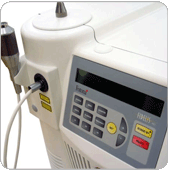 Lipolysis is the state-of-the-art technology in liposuction procedure. The procedure involves melting fatty tissue and cellulite by photomechanical effect of laser beams. In such intervention, a thin laser sound is inserted into the marked area of tissue, which is heated, i.e. sub dermal linking membranes as well as fatty cells membranes are melted. Fatty tissue transforms into fatty emulsion.
Lipolysis has a great advantage because it may melt fatty tissue below the skin itself, compared to standard liposuction, which cannot perform this even by microcannulas. This is extremely important in cases of very hard cellulite as well as in cases of correction of uneven area caused by classical liposuction.
Additionally, by the effect of laser beams, the creation of collagen and elastin is stimulated (tissue biostimulation) in sub dermal tissue, so the adaptation of skin, i.e. its shrinking after the procedure is more adequate. After the intervention, the skin looks smother; there is no roughness such as waves that are usually seen after standard liposuction. Elastic garment or in minor cases, compressive tights, are worn for 2-3 weeks.
If up to cca 300 ml of fatty tissue is to be melted it is not necessary to suck out additionally created fatty emulsion (INTERSTITIAL LASER LIPOPLASTY – Kim and Geronemus 2006), but in larger interventions it is usually performed by manual liposuction using a syringe with cannnulas of extremely small size (LASER ASSISTED LIPOSUCTION – Badin 2006).
ADVANTAGES:
Laser lipolysis is the latest technique that enables emulsification even of the hardest fatty tissue. Accompanying better adaptability of skin related to stimulating production of collagen and elastin (neocollagenesis – lifting result!), bleeding is much less (laser rays coagulate smaller blood vessels), so, due to that, the bruises are smaller. Also it is important to say that postoperative swells are smaller, it is less painful and possible inflammatory reactions are less likely, so the patient wears elastic garments or tights for a shorter period. All the above-mentioned leads to quite shorter postoperative recovery and much better final results that result in masterly removed fatty layers and in overall better condition of the skin on the treated area. Incisions through which the laser optical thread and microcannulas enter the tissue are 1-2mm in size.
ANESTHESIA:
Due to the size and number of areas, the intervention is performed in local (so called, tumescent), spinal or endotracheal anesthesia.
Extremely good thing about lipolysis is that the areas that were completely out of question in standard liposuction may now be treated. All the areas treated by laser lipolysis, postoperatively provide an excellent result with minimum trauma, without excessive swells, and with very little or no hematomas at all.

User Rating: 5 / 5


